The CFO Edit | Why Executives Confuse Risk with Fear
16 Sept, 20268
Many executives talk about risk when they mean fear. The two aren't the same, and mixing them up is the difference between something you can manage and something that just keeps you up at night.
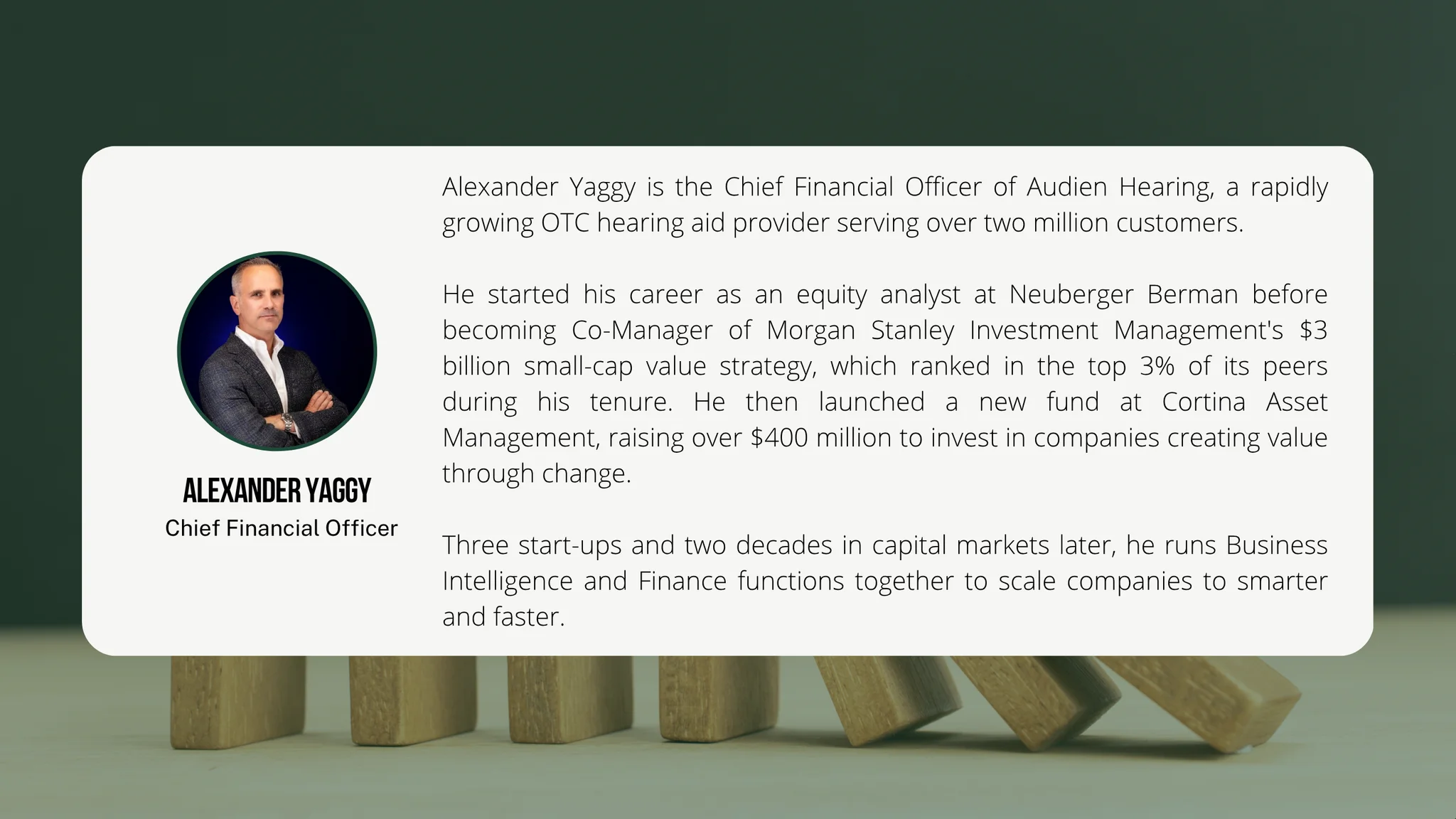
In this edition of CFO Edit, we sat down with Alexander Yaggy , CFO of Audien Hearing , to find out how twenty years of learning to separate risk from fear, first managing a $3 billion small-cap value portfolio at Morgan Stanley and then launching a new fund with Cortina Asset Management, now shape the decisions he makes in the CFO seat.
You started your career on Wall Street managing investment portfolios. How does that influence your approach to risk?
Twenty years on Wall Street taught me the importance of making choices that are uncomfortable in the moment but have exponential payoffs. Without risk there is no return. That makes for some hard decisions in the face of unknowns. No one ever has complete information, and as a manager you must accept that the gap is exactly why an opportunity exists in the first place.
That's really where the distinction starts. Most people use the word “risk” when they actually mean ”fear.” Fear is about the unknown, and the unknown is inherently uncontrollable. The first step is asking the right questions to reduce those unknowns, and once they decline to a certain point, managing fear and risk transforms into managing probabilities.
How did you manage risk then, and how does that translate into an operating role?
It really comes down to two things: fresh perspectives and managing volume.
Seeking a fresh perspective is the best defence against complacency which is at the heart of most risks that materialize. As portfolio managers we ran quarterly reviews of our thesis on every position, and it was amazing how often a high-conviction idea fell apart the moment we said it out loud again. Ask yourself, “what do you believe to be true that's wrong?” It's uncomfortable, especially with something you've championed, but it's how you might catch a big revenue number that's really masking bad unit economics underneath or a flawed assumption using old data.
Then there's volume. A CFO usually sees the risk before anyone else does, but a great chart only matters if people are truly listening, so you may need to speak louder than feels natural. I've been effective when I've walked the CEO or board through an issue in detail until it lands, and I've been ineffective when I've done the work but stopped short of making sure the message was heard. Sometimes you just need to be the loudest voice in the room.
As you said, risk seems both uncomfortable and unavoidable. How do you think about that tension as an executive?
Dwelling on risk can wear you down, but that edge is also what keeps people coming back to start-ups. Early on, mistakes are cheap: small teams, low costs, and speed make almost everything reversible.
The real challenge shows up later, once the company starts growing and success changes the equation. A win leads to growth, growth brings scale, and scale is what eventually pulls in the oversight, caution, and process you didn't need before. Handled badly, that's how an adventurous start-up slips into an organization more focused on protecting what exists when they should be constantly reinventing to drive improvements. Improvements in infrastructure and process should create a solid base enabling healthy growth efforts while ringfencing risks so no single miss can be fatal.
How do you evaluate which risks are worth taking and which aren't?
As CFO, your job is to identify risk, create solutions, and communicate urgency when it's needed, since your view into the company is usually more complete than anyone's, including the CEO. Once a risk is identified, it needs to be measured. Risk and return aren't linear: there's tail risk and tail opportunity, where low-probability outcomes far outpace anything on a straight line.
I think about it like skiing. Alpine skiers call certain moves high consequence turns. On an easy slope, a bad turn barely matters, but on a steep one the same mistake can mean a long fall. Good management means knowing which risks in front of you are like that: the ones where you can't afford to get it wrong, because no single decision should be able to sink the business.
R&D is one I'm comfortable with because while innovation may not always succeed, without it there's no growth. Rushing a product or a new hire is the opposite; a bad product launch can cost your reputation, and a rushed hire can set you back months.
Once you've identified those risks yourself, how do you get the rest of the team working within that same framework?
It starts with getting KPI and project updates shared across functions instead of locked inside them. When different teams see the same data, they tend to notice different things in it. There's a colleague of mine who always says transparency creates action, and I think that's exactly right. Don't let information sit on islands.
That collaboration only works if people are willing to speak up which requires a certain acceptance of conflict. I like having people from outside a process in the room. They'll often spot a risk that the people closest to it have stopped seeing, but only if leaders build an environment where concerns can be voiced and a question reads as being about the information, not a dig at someone's work.
Even then, I'm careful not to let a good discussion skip straight to a fix. I want alignment on what the problem or opportunity is before anyone jumps to a recommendation, because jumping straight to a solution short-circuits discovery. Plenty of problems fester when people hate the solution more than the problem itself.
Structurally, how do you implement a risk management process?
Three ways, really: decision trees, logistics, and data. The risks that get you are usually internal, not external. Short-term fixes create long-term problems, especially when you're growing fast and they grow right alongside the revenue, unnoticed.
- Decision trees keep it simple: if a choice leads to outcome A or outcome B, are you better or worse off either way? We could cut R&D to hit this quarter's profit target, but missing a near-term number is a lot less risky than losing the innovation we need to grow.
- Logistics is asking what must be true in order to get where you want to go. Whether it’s getting a product on a retailer’s shelf or launching a marketplace in a new city, there is an entire stack of systems that needs completion. Shipping before the systems are ready could lead to later fixes that greatly exceed the initial time saved and bad customer experiences that are costly to repair.
- Data is critical. At all three start-ups I have joined, day one has always been about starting with the data, not just the data warehouse, but the organization of the actual data tables. At Audien, in my first eight weeks, the team built a warehouse in Snowflake, added Omni Analytics on top, and very quickly we could see things we couldn't before, like returns spiking after a certain number of days, which led to fixes that cut returns by a third.
Can you give an example of a risk you saw and successfully mitigated?
In 2022, I told the board of our company, CareRev, that we needed to strengthen our capital structure, even though our Series B had closed just three days earlier and, on paper, we felt safe. But twenty years on Wall Street gave me the tools to see that buoyant indexes were masking problems underneath, and the Fed raising rates usually precedes credit contraction and venture money pulling back.
Our potential vulnerability was liquidity. Clients paid us in 30 to 60 days, but nurses on our platform were paid in days. Without a solid credit line, one shock could trigger a cash crunch even with a strong balance sheet. Our bank was Silicon Valley Bank, and working at Morgan Stanley in 2008 taught me never to ignore counterparty risk. It took a summer of long hours with the bank, lawyers, and the board, but we built a $70 million credit facility with JP Morgan months before SVB collapsed.
What about an example of a risk you failed to properly identify?
Building a team is one of the best parts of working at a growing company; the right people are force multipliers. But one thing I got wrong in the past was overhiring. At a previous company we were growing fast, under pressure to add headcount from every direction, and it all made sense in the moment. Before we knew it, we'd gone from 75 people to 300, and everyone still felt understaffed.
But when growth slowed, we were quickly overstaffed and had to cut headcount. It was hard on the company and on the people affected. A phrase has stuck with me since: how am I complicit in my own situation? I signed off on those hires. I should have said no to some of them. Now we don't bring someone on until it almost hurts because having too many people on payroll is a much bigger problem the moment growth slows down.
What advice would you give early-career, aspiring CFOs about managing risk?
Build a solid foundation of data, because you can't manage what you can't see clearly. Question everything, even the answers that feel comfortable. Risk is a valuable currency, spend it wisely.