Hiring a CFO: How to Assess Candidates Effectively
23 Sept, 2026



Fundraising is one of the most high-stakes processes a founder will ever run, yet many still approach it reactively rather than with the same rigour they'd apply to any other critical business function.
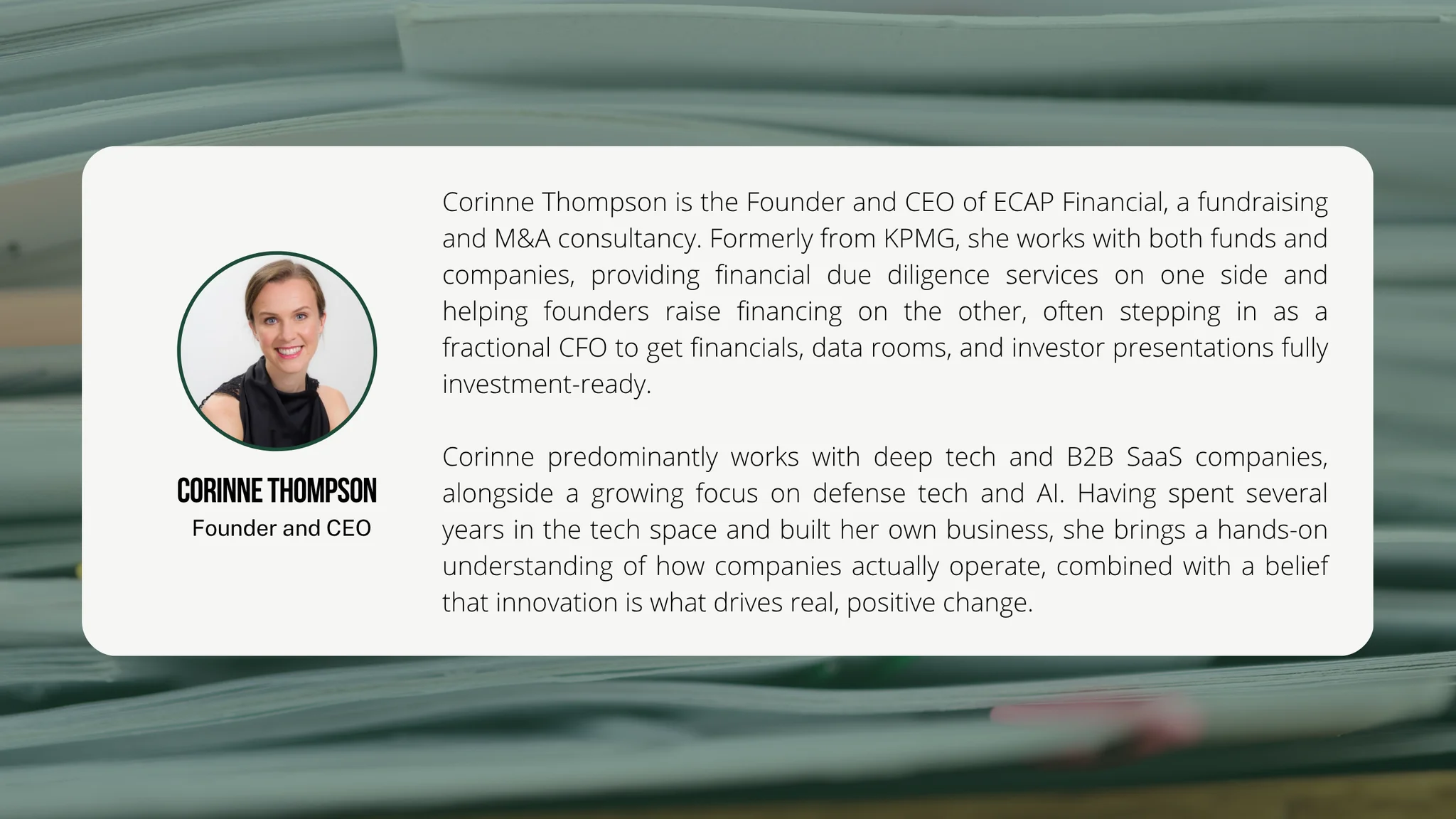
In this edition of CFO Edit, we sat down with Corinne Thompson (ACA) , Founder and CEO of Ecap Financial, to unpack what's actually changed in investor scrutiny over the past year and why the founders who raise fastest treat the entire process like a structured sales pipeline. She also gets into the data room mistakes that quietly kill momentum and what it takes to keep multiple investors moving in step, right through to close.
There's a lot of money going into AI companies at the moment, and honestly, the investment frenzy we saw in 2021 is what I see being repeated now, just with AI as the theme this time. Scrutiny in that space is limited, deals are moving fast, and there's a real appetite to not miss out.
For more traditional companies, the scrutiny looks different. Investors are far more focused on making sure the underlying technology won't be cannibalised by AI further down the line. We helped one company raise fresh capital recently, and when the investors carried out their technology due diligence, they actually hired a firm to try and rebuild the company's tech using AI. That was the tech due diligence, because if AI could replicate what they'd built, that would tell the investors how defensible the business actually was.
Revenue quality has become a much sharper focus. Investors want to know whether the ARR being reported is true ARR, or whether it's being padded out with discounts, POCs, or one-off revenues that won't repeat. This is something we get asked to dig into constantly on the financial due diligences we run, and it's rarely as clean as the headline number suggests.
The other area getting a lot more attention is how much AI a company is using internally to run efficiently. Investors want to see it reflected in the numbers, and that's playing out most clearly in metrics like ARR per FTE. If a company can show it's generating more revenue per employee because AI is doing some of the heavy lifting, that's becoming a real signal of operational efficiency and future scalability.
A few things stand out, but they build on each other.
Fundraising is hard, it can wear anyone down, and maintaining a strong, can-do attitude throughout is honestly one of the most underrated skills a founder needs in this process.
There's a saying that investors go to die in data rooms, and it's true. The mistake most founders make is treating the data room as one big bucket, when it should really be split into two.
Founders who front-load data room 1 with this kind of material kill momentum almost immediately. Investors lose interest fast when they're wading through legal paperwork before they've even had the chance to get excited about the business.
Ideally 4-8 weeks before formally launching the raise. That gives enough time to pull everything together properly without rushing, and rushing is exactly how inconsistencies creep in.
Ownership matters just as much as timing. It should sit with someone who's genuinely good at project management, but just as importantly, someone who will actually review the documents against each other to make sure the story holds together consistently throughout, and that there are no errors or contradictions between what's being said in different parts of the data room.
One person needs to hold the pen. That person doesn't have to be the CFO, it could just as easily be a COO or a Chief of Staff, but there needs to be a single owner accountable for the whole picture, rather than different people uploading pieces in isolation.
Treat the round like a structured sales process, because that's essentially what it is.
Have one tracker covering every investor: stage, last interaction, information provided, outstanding questions, and next action. It sounds simple, but it's the single biggest thing that keeps a process organised. From there, try to keep investors moving through roughly the same timetable.
The mistake most founders make is letting one investor run ahead at full speed while another falls three weeks behind. Once that gap opens up, leverage disappears, because leverage comes from having credible alternatives at roughly the same stage of the process at the same time. If everyone's moving together, you're negotiating from a position of choice.
Numbers that don't reconcile, that's the big one.
If the board pack says one ARR number, the deck says another, and the model shows something slightly different again, investors notice immediately, and it doesn't take much for that small inconsistency to become a much bigger concern. The moment the numbers stop lining up, investors start wondering what else in the data room they can't fully rely on. It undermines trust in the finance function fast, even if the underlying business is genuinely strong, because it signals a lack of rigour and control at exactly the point where investors need to feel confident in what they're being shown.
Have a single source of truth, and build everything else outwards from there rather than creating separate versions for each investor from scratch.
Keep a clear record of exactly what's been shared with whom. Version control sounds incredibly boring, and most founders don't think twice about it early on, but the moment you're halfway through a raise, juggling multiple investors, formats, and follow-up requests, it becomes one of the most important things you can have in place.
A few things I always come back to:
Fundraising is exhausting, and founders need every advantage they can get to stay engaged and positive throughout.
Make the financial story completely investable.
Investors are economic animals. They care about the narrative, of course, but what they really care about is the financials and the model underneath it. If a founder could fix just one thing, it would be making sure that story is airtight: clearly explaining what's been raised to date, what's actually been achieved with that capital, and then a credible, well-reasoned picture of what the next raise will fund and what it will go on to deliver.
Get that link between capital, execution, and future outcomes clear and investable, and everything else about the process gets easier, including the terms you're able to negotiate.
 Site by Venn