The CFO Edit | AI in Finance: How AI Is Reshaping the Finance Function
29 Jul, 20268
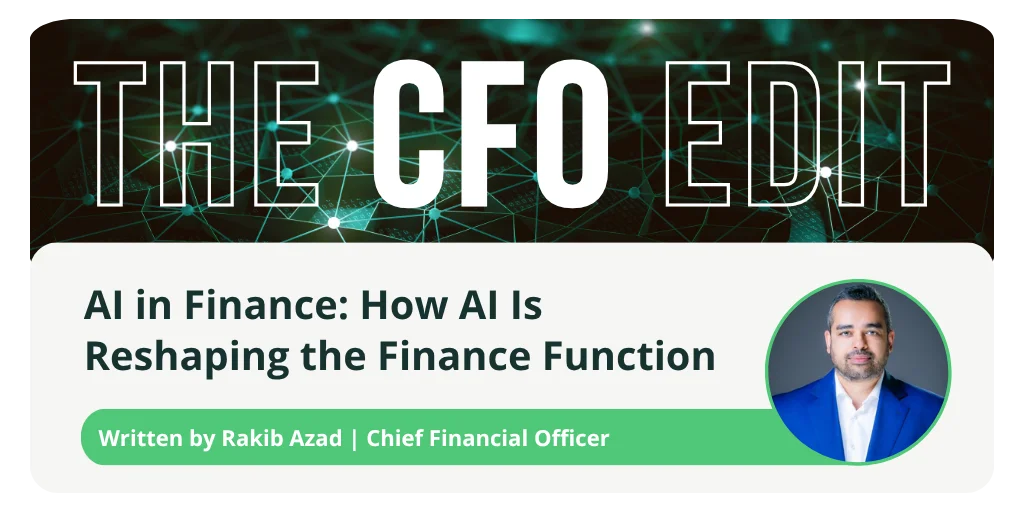
AI has already changed how finance functions operate, and much of that shift comes down to how finance leaders think about judgment, accountability, and where human oversight still matters most.
In this edition of CFO Edit, we sat down with Rakib Azad to explore what a best-in-class AI-powered finance function looks like today, where the biggest implementation gaps are, and what it means to build a team that can keep pace with AI without losing the discipline that makes finance trustworthy in the first place.
When you imagine a "best in class" AI finance function five years from now, what does the finance team actually spend its time on that it doesn't today?
It's already apparent that core finance workflows, such as AP and order-to-cash, have the tools and platforms in place to become close to fully autonomous. Big chunks of FP&A, financial modeling included, should reach a similar level of autonomy. A human will still need to prompt through assumption drivers and the like, but beyond that, it's about getting intelligence to stakeholders across the organization as quickly as possible, so they can act on financial and strategic goals faster.
This will almost certainly lead to leaner finance teams, but the talent within them will need to be more specialized. On the accounting and controls side, you'll need people who can provide technical control and internal audit services, not just on financial outputs, but on the design and inputs of the AI systems producing them. External auditors will have to evolve in the same direction. Rather than auditing large volumes of individual transactions, their focus will shift toward analyzing the AI systems and workflows behind them.
How do you decide which finance processes are worth automating with AI versus which should stay human-led?
While I foresee every workflow having AI processes built into it, everything should still start with a human leading the design of the process. Even something like AP may have company-specific considerations and should be designed properly.
The processes that are the most repetitive and rule-based are the ones that should be run almost entirely or entirely autonomously. But final decisions in complex workflows should always stay with the human.
What's been the biggest gap between the promise of AI tools and the reality of implementing them in a finance function?
Right now, for internal teams, there isn't enough expertise on what AI can truly unlock, which can lead to underoptimization. What makes the task even harder is that things are changing and improving on an almost daily basis, it's almost impossible to keep up. In the coming months and years, finance professionals will have to answer the call to get very in tune and have close to real-time knowledge on what they can bring back to their team and company. I know I will be looking for these personas in the future.
Another bottleneck in all of this is data fragmentation. Running these processes effectively depends on unified data. That's straightforward enough in single-stream workflows, but in more complex, multi-source workflows, clean data unification is a prerequisite.
How do you approach build vs. buy when it comes to AI tools for finance, off-the-shelf platforms, custom builds, or a hybrid?
I don't have a definitive view on this yet, but my current orientation is strongly hybrid. Things are changing so quickly that custom builds are becoming more feasible than ever. That said, established players in the office of the CFO can still adjust to this reality. If a platform specializes in AP and T&E, for example, it can provide more building blocks for organizations to build to their own specifications, doing much of the heavy lifting along the way.
We're entering an age where platforms will need to form-fit to each company, and the AI foundation is already there to make that possible.
What does the AI-augmented finance stack look like at your company today, and what's still missing?
Right now, we've built robust processes on Ramp for spend and Tabs for order-to-cash and revenue, both AI-first platforms. We're also working on more bespoke automations and workflows using Claude Cowork, though it's still early days there.
What's still missing is true orchestration, and that's going to be a focus of mine going forward. If this is done right, finance has a real chance to become the strategic and operating decision system of a company.
How is the skillset you look for in finance hires changing as AI takes on more of the traditional analyst workload?
Being a functional expert, whether in accounting, FP&A, or elsewhere, is table stakes. Layered on top of that, two areas will matter most:
- First, strong communication and interpersonal skills, particularly in FP&A
- Second, a strong bias toward action when it comes to AI-driven thinking, design, and execution, all in service of getting to decision intelligence and analysis faster than ever before.
There's plenty of value in people who lean stronger toward one of these areas than the other, but those who show real strength in both will be the future leaders of the finance function, and beyond.
How do you keep your team's judgment sharp when AI is doing more of the number-crunching for them?
This is very much a work in progress, but the focus is on questioning the intelligence that's produced, rather than accepting it at face value. Stress test the output and ask whether these numbers actually make sense given the strategy of the business.
If AI is producing decisions or forecasts, challenge and test that output the same way you would if a colleague brought it to you. The moment you stop questioning the numbers because a model produced them rather than a person, you've lost the judgment that actually matters.
What guardrails do you think are non-negotiable when using AI for financial reporting or forecasting?
The governance a company already has in place shouldn't be thrown out just because AI is now part of the process. Every output still needs to be auditable. Segregation of duties, approval workflows, all of that still applies, and arguably matters more, not less, once AI is involved. The tools change, but the discipline around them shouldn't.
How do you think about accountability when an AI model contributes to a financial decision that turns out to be wrong?
We're still in a world, and maybe this is permanent, where AI models shouldn't be enacting new decisions into irreversible workflows without a human in the loop to review and sign off. Accountability has to sit with a person, not a model. If a decision can't be undone, that's exactly the point where human judgment needs to be in the process, not just the AI's output.
If you were advising a Series A or B company building their finance function from scratch today, what would you tell them to get right early on the AI side?
If there are tools already available that let you run your processes with an AI-first foundation, you should be building on those from day one. If you're setting up AP, AR, or month-end reconciliations the same way you did at your last role, you're already behind before you've even started.
The same goes for financial modeling. You absolutely shouldn't be spending more time building the model itself these days, the tools exist to get that done faster than ever. What matters is how quickly you can get from the model to strategic decision intelligence, that's where the real value sits, and it's where finance leaders should be spending their time.