The CFO Edit | Why Executives Confuse Risk with Fear
16 Sept, 2026

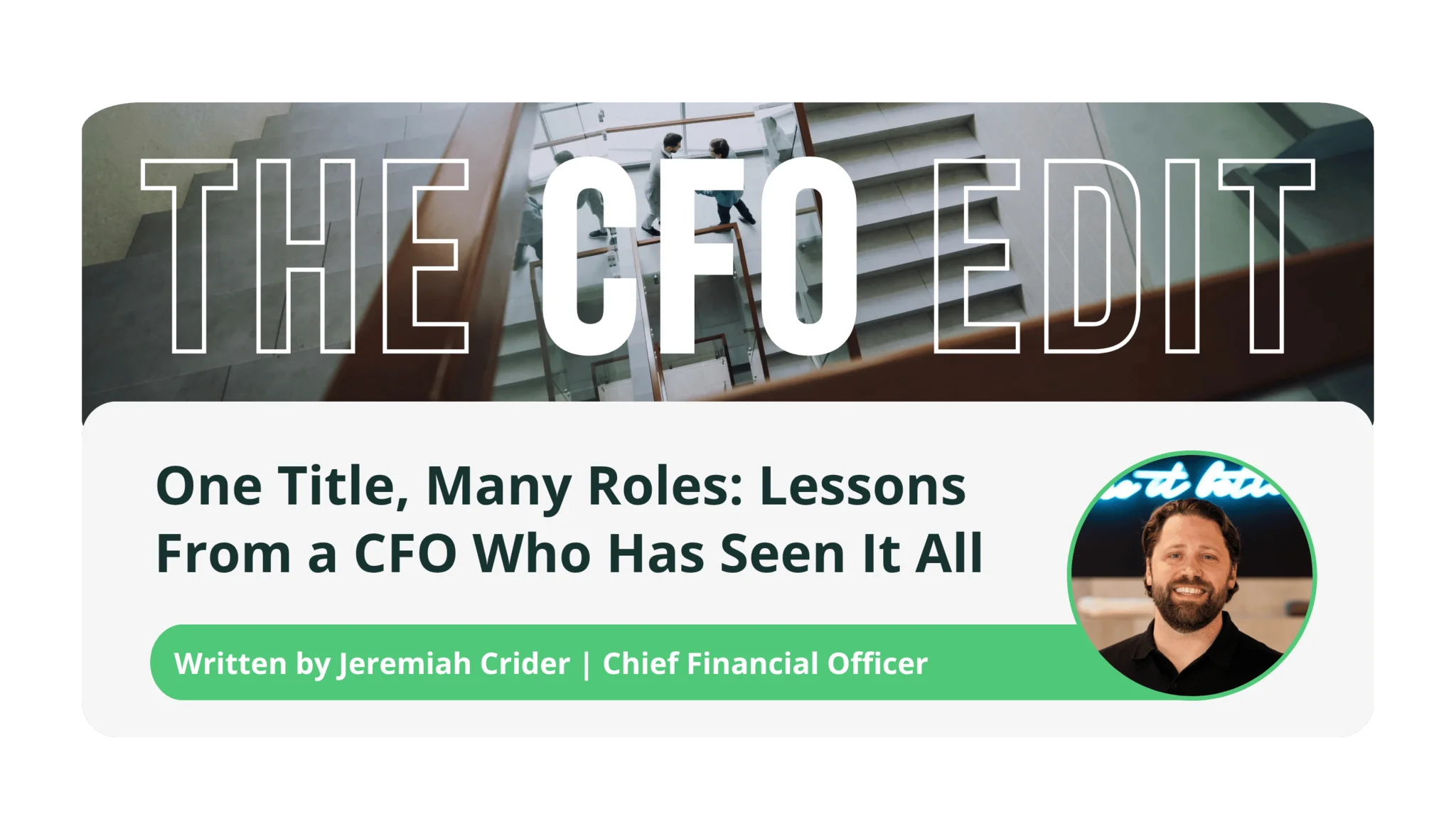
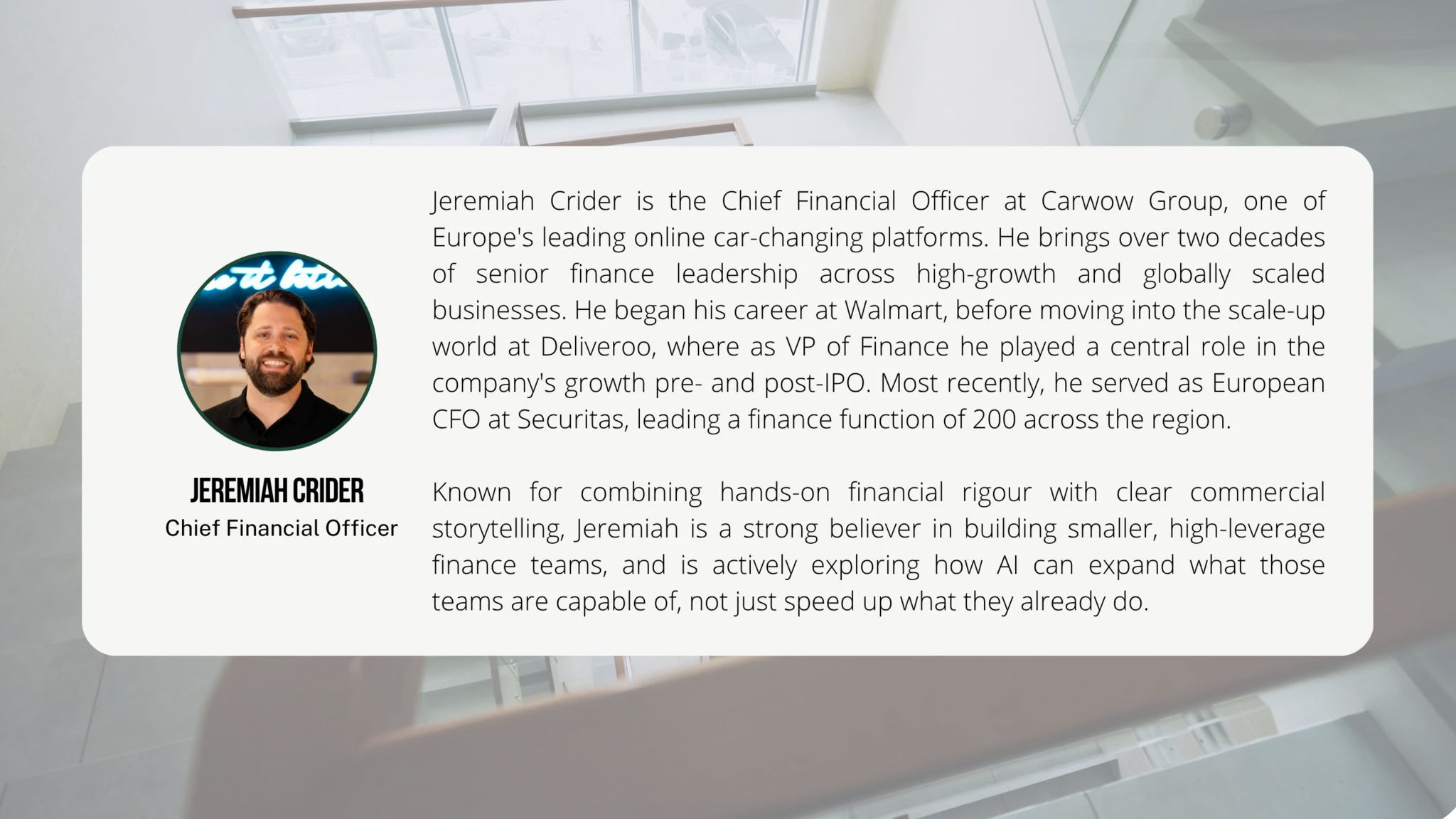
Great finance leaders are shaped by the businesses they've worked in, and few have worked across a more varied range than Jeremiah C. . From the operational discipline of Walmart to the pace of Deliveroo's IPO journey, and the balance sheet complexity of Securitas, Jeremiah has built a career that spans almost every version of the CFO role.
Now CFO at Carwow Group, one of Europe's leading car-changing platforms, he sat down with us to share his thinking on what great financial leadership really looks like, how finance earns its place in the big decisions, and why he believes the age of AI rewards the smallest, sharpest teams.
I've never thought of CFO as one job. Every business I've been in needed a different version of it, and that's really what's shaped how I lead.
Walmart was about discipline. At that scale, consistency is the thing that lets the machine run. This early experience set the tone for what good looks like in a process, or in a rhythm and how powerful a force a strong culture can be.
Deliveroo was the scale-up: everything moving at once, decisions made at pace, often before the data was as clean as you'd have liked. The job was to build financial discipline in flight, without becoming the thing that slowed the business down. It taught me how much prioritisation matters when the pace is relentless: knowing the few things that genuinely move the business, and having the conviction to let the rest wait.
Securitas was where the balance sheet and cash mechanics mattered as much as the P&L: recurring revenue, deferred revenue, working capital, the gap between profit and cash. It was also an education in M&A. I came to appreciate how much a deal's success rides on the quality of the implementation plan behind it, and how heavily a poorly designed integration can weigh on an organisation and the people asked to deliver it.
Carwow pulls all of it together: the discipline, the pace, the cash rigour. Every lesson the others taught me is needed at once.
My first few months came down to three connected things: the business, its people, and its rhythms. Any CFO has to deeply understand how the business really makes its money and where its costs come from, which means studying the economics behind each revenue stream.
I also spent a lot of time with the team, working out where the real capability sat and deepening relationships with the leaders around me. You're really answering one question: is this organisation set up for success, or do I need to make changes? In my view, you have less than 90 days to decide, and you have to move decisively. Trust your instinct.
And lastly, I studied how the company actually worked. What I like to call its rhythms: the recurring processes and meetings where you make decisions, manage performance, forecast or plan the business, close the books, etc. Rhythms are so important and will tell you a lot about the company's actual culture versus what's just painted on the wall. And even with a few basic changes, we drove real improvements early, especially around working capital efficiency, making what we already had work better.
A high-performing team, finance or otherwise, comes down to a lot of things that are hard to see in a stack of CVs. First, mutual respect and trust, built on accountability. Everyone carries their weight, and there's something of an allergic reaction to big egos: talent isn't a licence to be a jerk. Second, clearly defined roles: everyone knows what they own, but when responsibilities overlap, and they always do, it builds cohesion, not friction. And third, a growth mindset, people who refuse to accept the status quo, always asking how we make it better and taking it on themselves to do it, even if it's not in the job description.
There's also a harder truth about scale: the bigger the company, the harder it is to keep talent concentrated and teams performing at a high level. At Deliveroo our teams were a fraction of Walmart's, but pound for pound the talent was exceptional. You felt it in the speed of diagnosing issues and the pace of action. That's why I'm excited to be building smaller, higher-leverage teams at Carwow. Get the people and the standards right, enable them with the right tools, and a small team can outperform a much bigger one consistently. In an age of AI, being small is actually an advantage. Fast, cheap, good. You used to pick two. AI breaks that trade-off, and small teams can get all three at once, while a bigger group, same tools or not, still pays for its size and all the layers.
Storytelling. It's one of the most underrated skills in finance, and I was lucky to learn it early at Walmart, working alongside people who were exceptional at it. Most of the people you're trying to influence aren't finance people, so taking something complex and turning it into a clear, simple narrative, explaining what's happening, connecting the dots, and leading people from one conclusion to the next. It's rarely the numbers that change someone's mind. It's the story you wrap around them.
The second is being genuinely hands-on, in the detail, not above it. A lot of finance leaders sit too far above the numbers and focus heavily on just the outputs of the P&L or cashflow. The best know when to zoom out and set direction, and when to dive deep into the detail. I think of it as being able to dolphin between the two. What lets you do that is curiosity and persistence, and you have to be wired a bit differently for it: the curiosity to keep asking questions when something doesn't make sense, and the persistence to keep digging until it does. The real answer is almost always a layer below the obvious one, and a lot of people stop before they get there.
For me, it's less about a point in time and more about earning the right. Finance doesn't become embedded because it wants to be. It earns its way there, through a clear progression.
It starts with the basics, done really well: reporting, reconciliations, month-end, accruals, controls. Not glamorous, but it's what protects the company and keeps it accurate and compliant. Get it wrong, errors, surprises, misses, and you haven't earned the right to a say in the bigger decisions. Nothing drags a finance team back to the dark ages faster than getting the numbers wrong.
Once that's solid, you have to actually create value. One of the biggest opportunities comes from where finance sits. It's one of the few roles that looks across the full group, which puts it in a unique position to connect dots and bridge silos. An example from Deliveroo was finding the right input metrics that tied the three sides of the marketplace together: how rider supply drove delivery times, how those times drove whether a customer came back, and how that fed through to restaurant volumes and each market's unit economics. No single team saw the whole chain, but finance did. We surfaced it through our business reviews, and that's where we improved decision quality and pace.
Another place finance can add value is driving accountability. A lot of people find this uncomfortable. They don't want to "police" the organisation. But the truth is, people aren't always self-motivated, and don't always make decisions aligned with the company's goals. In my experience, what gets measured gets done, and finance is the function best placed to make that happen.
And finally, credibility, which you earn by adding value as mentioned but also by knowing the business as well as the people you support, sometimes better: how the marketing mix really works, how the logistics actually flow, the ins and outs of the product. The best finance partners could run their stakeholder's area for a couple of weeks if they went on holiday. That's the bar. Knowing the business and bringing financial discipline to it is how you become a true co-pilot in the big decisions, not the function that just reports on them.
I think the noise is really just uncertainty about the future of this technology. There's a lot of experimentation, but most teams don't really know where they're going with it, caught somewhere between a fear of being replaced and the excitement of radically improving how they work. And that's true for most people, not just finance. My view is that the future is never as bad as the doomers say, and never quite as good as the evangelists promise, so what matters is staying hands-on, curious, and pragmatic about where you actually are as a company and team. The value should show up in two places: efficiency and capability expansion.
We're seeing both at Carwow. On efficiency, a lot of repetitive finance work, month-end, reconciliations, model-building, the performance rhythms, is much faster now. Though it's more like 80/20 in practice: AI does the bulk of the legwork upfront, the building and the formatting, but the last 20%, iterating, problem-solving, prompting, the QA, is still on you. We're starting to see agents help drive first-time speed and quality, but there's still a fair amount of intervention. Even so, having most of it built buys us time to think more strategically, and lets us ride out surge periods without paying for temporary support.
The more exciting shift has been in capability, not the same work done faster, but things the team simply couldn't do: building our own dashboards and process flows, supporting more of the business with the same team, increasing our predictive accuracy, and pulling insights from datasets too wide and fragmented to interrogate before. We can even standardise how the team works by building it into reusable skills, far faster than training everyone one by one.
A lot of people assume AI will be the great equaliser, that now anyone can code in plain English and build whatever they want, so we all end up on a level playing field. I don't think that's true. In my experience it's acting more like a great revealer: it exposes who's adapting and who isn't, and not using it effectively now is like coming to work without your laptop. More than that, it makes your best people dramatically better and widens the gap to lower performers, because the traits that already set them apart are the ones AI amplifies.
And those skills aren't new. Curiosity and a willingness to experiment, because the people who continuously try new approaches adapt to change faster. Judgement and hands-on experience, because AI will hand you a confident answer whether it's right or not, and you have to catch the difference. First-principles thinking and asking the right question, since what you get out is only as good as what you put in. Structured thinking and communication, to turn the outputs into a story people act on. And emotional intelligence, which is about to matter even more: as AI takes the routine solo work off your plate, more of your time goes towards other people, bigger problems and influencing others to act.
I would start with these three things:
First, fix the structure before the process. AI is only as good as the foundations under it. Point it at broken data, or at a problem that really needs a structural or strategic fix, and you don't solve anything, you just hide it, and burn tokens doing it.
Second, be pragmatic. Find the specific, repeatable use cases where it removes real friction or solves a real business problem, rather than sprinkling AI magic everywhere and hoping.
Third, get your own hands dirty and experiment. Actually use the tools yourself rather than delegating the learning. Lean on your CTO, engineering teams and known super users. Chances are they're well ahead and can teach you and your team new tricks or push your thinking in new directions. Bring your team with you. Build proofs of concept together, celebrate the wins, and share what works.
 Site by Venn