The CFO Edit | Why Executives Confuse Risk with Fear
16 Sept, 2026



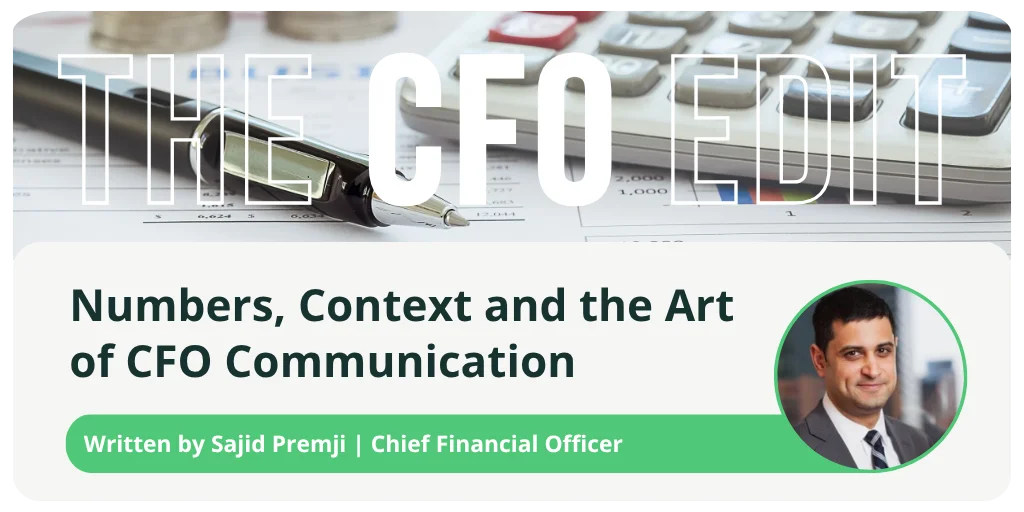
Every CFO eventually has to stand in front of a board and explain a quarter that missed. How you do it matters almost as much as the miss itself. In this edition of The CFO Edit, we speak to Sajid Premji about how CFOs can communicate disappointing results without losing credibility. He also shares how lessons from his background in audit and financial-crime compliance continue to shape his approach to risk, and how to identify the KPIs that reveal what the financials alone cannot.
Audit is the part of my background most people can relate to, since so many of us have been on the receiving end of one. Having sat on the other side of the table is extremely valuable. You understand the assertions an auditor is testing, like completeness and cut-off, and what it takes for a file to hold up through their internal review and any regulatory inspection. That's a big part of how credibility gets built, from how working papers are organised to the accounting policy memos that support your positions. As a CFO, I still think about whether a position would hold up if someone challenged it.
Financial-crime compliance is the more unusual part of my background, and in many ways it has had the bigger impact. At its core, the job is weighing risk against cost and making a call, which is what a CFO does every day. The audit and accounting skillset translates well to that risk-based approach, which is why financial-crime teams often include many CPAs, even in the most senior roles. With multi-billion-dollar fines and serious reputational damage at stake, compliance also has a real seat at the table.
A few lessons have stayed with me:
Even the most exciting industries, AI included, have their ups and downs, and so does the broader economy, and every organization eventually has a quarter that falls short of expectations. In advertising, where I've spent the last several years, that's especially true: budgets shift fast when consumers pull back, and the industry keeps getting reshaped by new technology.
When that happens, my approach is to lead with the number rather than shy away from it, then give the context that tells the fuller story. Owning it upfront is what keeps that context from sounding defensive. Investors and boards will forgive a bad quarter, even a bad year, as long as the long-term vision stays credible. It's when weak numbers come paired with a vision people can't follow that they start to worry.
It starts with a defined set of KPIs, a regular weather check on the business. Some are lagging, like margins and renewal rates. Others are leading, like how fast deals move through the pipeline.
From there, don't live in your own bubble. Watch where interest rates and policy are heading, listen to how your customers (and competitors) are talking about their own results, and ask your sales teams what they're hearing on the ground. If someone's leaving over price, or shifting to something they don't think you offer, that's real signal.
If the outside world explains most of what you're seeing and the leading indicators are holding up, I'd call it noise. If customers are telling you they're going elsewhere, I'd take that seriously.
I think the two biggest mistakes are changing how you report from quarter to quarter, and failing to connect results back to the long-term vision.
Reporting should evolve over time, but that's different from reshuffling a board presentation based on how the quarter went, moving the positives up and burying the negatives. It costs you credibility, because people start wondering what you're hiding.
On the second, a headline number can disappoint for many reasons. What matters more is whether the business is still moving toward where you said it was going. Every leadership team has a handful of measures it uses to judge that, such as the share of revenue from returning customers or the growth of newer products. If those are healthy, a soft quarter looks very different than if they're slipping too. Breaking results down by segment helps show that too: whether a weakness is isolated to one product or region, or spreading across the business.
A general ledger is very good at telling you what happened. It's not very good at telling you why, or what's likely to happen next, so the KPIs worth relying on are the ones that fill that gap.
In advertising, cyclical events like the Olympics or a major election swing revenue in ways that have more to do with the calendar than the underlying health of the business, so the KPIs that matter are the ones that take those cycles into account.
It also helps to reach out across the organization. The sales department usually has a few numbers they live by every morning, and if finance is tracking something different, that disconnect needs addressing.
A good KPI should move before the financials do, and if it doesn't point to where results end up going, it probably isn't a very good one. Don't try to boil the ocean either, if everything is a KPI, nothing is.
Context should help investors, boards, analysts and employees understand the business in the same way management does. If there’s a KPI we genuinely use to judge the health of the business and whether we’re on track, people should be able to see it too.
Not every metric needs to be shared publicly or with the board, but if it’s one we regularly report, selectively leaving it out when it looks unfavourable, or giving an explanation we don’t fully believe ourselves, is where context becomes an excuse.
Numbers can tell you what happened, but they rarely tell you the whole story. For CFOs, the real value comes from understanding what sits behind those numbers and being able to explain it with clarity and credibility.
Whether the problem is a weak quarter or a shift in how customers behave, the job is the same: work out what's noise, then explain what's left honestly. Sajid makes that sound less like a technique and more like a habit built over years in audit and compliance.
 Site by Venn