The CFO Edit | FX Strategy for CFOs: How to Manage Risk in a Volatile Market
27 Mar, 20268
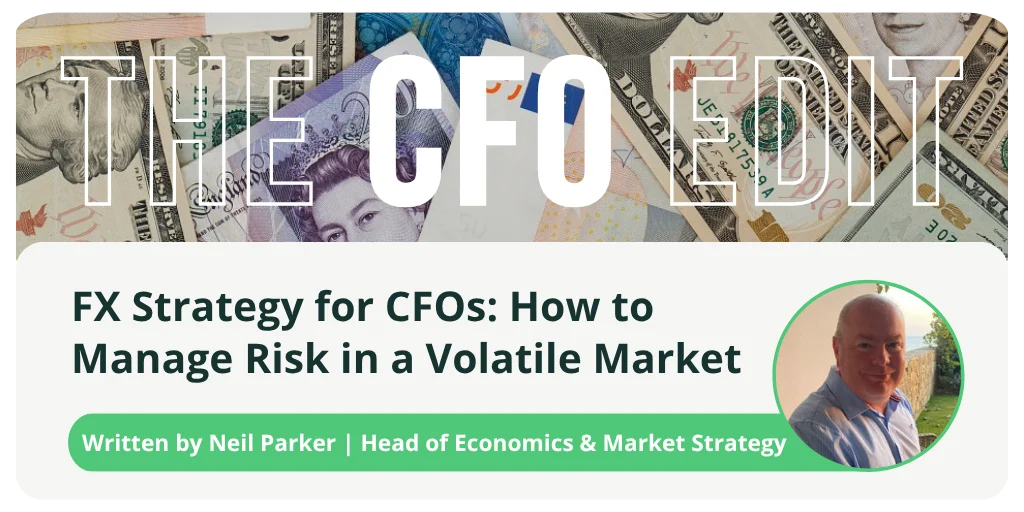
In this interview, Neil Parker, Head of Economics and Market Strategy at Moneycorp , shares his insights on foreign exchange (FX) risk and how CFOs can navigate a volatile market.
From understanding implicit and explicit exposures to managing currency fluctuations through treasury policies and hedging strategies, Neil offers practical guidance for businesses of all sizes. He also explores how FX risk can be incorporated into scenario planning and forecasting, helping companies make informed decisions without being caught off guard by market movements.
How do CFOs best assess if they're exposed to FX risk across their business?
CFOs need a solid understanding of their business, including where it operates, what it does, and the types of transactions it undertakes. FX risk is not always obvious; it can be implicit as well as explicit.
For example, a company outside the US exposed to energy prices is also implicitly exposed to FX, as energy is typically priced in US dollars. Even if you are not directly trading currencies, fluctuations can affect your costs.
Similarly, if you import goods through a wholesaler who prices in your domestic currency, the underlying charges may still be in another currency, creating implicit FX risk.
Explicit FX risk arises when you transact directly in a foreign currency, such as paying a manufacturer in euros while your domestic currency is pounds.
Understanding both implicit and explicit exposures helps CFOs manage FX risk proactively.
How does current FX market volatility compare to Covid or the 2008 financial crisis?
Volatility is usually low during normal economic cycles but spikes sharply during crises. In past events, such as Covid or the 2008 financial crisis, volatility surged because economic activity or liquidity was disrupted, creating much larger FX movements.
After a crisis, volatility often falls quickly, aided by central bank and fiscal interventions. The measure of volatility reflects the likely range a currency could move in a given period, capturing uncertainty.
Currently, volatility has increased but not to the extent seen during Covid, which halted economic activity, or 2008, which involved severe liquidity and credit issues. Today’s FX stress is more regional, linked to energy markets, and banks are not under the same strain as in previous crises, at least not yet.
How can FX volatility impact runway and burn rates, and how can CFOs manage it?
If a company raises funds in dollars and then it weakens by 5 or 10 per cent before it is converted into other currencies, it could run out of money sooner than expected. CFOs need to consider FX risk when planning a fundraise, potentially raising slightly more to cover possible currency fluctuations, or implementing a hedging policy.
FX movements can also work in a company’s favour, meaning less capital may be needed than initially expected. The key is to smooth the impact of FX changes by using FX hedging techniques to align conversion rates with budgeted deployment rates.
Most funds are deployed across multiple currencies and it is increasingly usual to fundraise in different currencies to how they are spent. This introduces potential additional FX risk or uncertainty.
How should global businesses allocate funds across different currencies?
There is no one-size-fits-all approach. Allocation depends on where the business operates and where funds need to be deployed.
However, around 75 to 80 per cent of daily FX market activity is in US dollars, which indicates where liquidity is strongest. Major currencies like the US dollar, euro, sterling, Swiss franc, Japanese yen, and Canadian dollar are most liquid.
Liquidity is more limited in emerging market currencies. For example, trading the Chinese renminbi typically requires using the offshore market (CNH) rather than the onshore market (CNY).
In Asia, companies often use the US dollar as a proxy instead of local currencies because of better liquidity, but there may still be local currency needs (payroll, rent, bills etc). Businesses should consider both operational needs and market liquidity when planning currency allocations.
What FX products should CFOs use to manage risk proactively?
CFOs can use a mix of products, including spot and forward contracts, and structured options. Spot contracts settle two days after the transaction. Forward contracts can range from same-day to several years, though liquidity can reduce the further out you go. Structured options give flexibility, providing the right but not the obligation to transact at certain rates.
The choice of product depends on the timing and certainty of fund deployment. For stage payments, forward contracts are suitable, while options may be better when timing or funding needs are uncertain.
Many businesses use a blend of products to avoid trying to time the market perfectly. Treasury policies often guide how funds are deployed and hedged, and should be revisited regularly to remain fit for purpose. New products can be introduced as needed to manage risk effectively.
What should CFOs consider when building their first treasury plan?
The most important first step is to speak with your provider. They have experience with other companies’ treasury plans and can assess what makes sense for your business.
A treasury plan should allow flexibility. For example, with stage payments, you might not want to hedge everything immediately. A common approach is a step-down hedging strategy: hedge almost fully in the short term (0–3 months), then reduce gradually for 3–6 months, 6–9 months, and so on.
The plan should be reviewed regularly, monthly or quarterly, to top up hedges and smooth FX impacts. At the same time, it needs to be agile, allowing the business to take advantage of favourable market movements without being constrained by the policy.
How should FX risk be communicated at board level?
FX should be treated as a risk management activity, not a profit centre. Boards should approve the treasury policy and budget rates by agreeing the parameters in advance and communicating this in annual reports.
Different board members may have greater or smaller risk appetite when it comes to FX, so finding a balance and ensuring everyone understands the risks is key. FX hedging should be seen as protecting the business.
Boards should understand that markets will be volatile. There will be times when the business benefits and times when it does not, but the focus is on safeguarding the company from adverse moves. The effectiveness of the treasury policy and FX function will be scrutinised, rather than individual currency movements.
What happens if FX moves unfavourably and nothing is done, and how does the treasury policy help?
Some events are beyond control and can create significant FX impacts in a given quarter. However, a proactive and well-designed treasury policy helps smooth these bumps.
It prevents earnings or costs from being severely affected by currency swings, protecting both sides of the balance sheet. Not everything is controllable, but a robust policy mitigates risk over time.
Historical crises, such as the global financial crisis or Covid, show how sudden and severe FX movements can be. Companies with a strong hedging framework can manage exposure more effectively, even when faced with unexpected market shocks.
How should CFOs incorporate FX into scenario planning and forecasting?
CFOs should take a cautious approach when setting budget rates. Don’t assume current market levels are guaranteed. Build in leeway so the budget does not need constant adjustment.
FX risk should be introduced gradually, especially in startups. As the business grows, FX exposure can increase, so educating all key players is essential.
Scenario planning involves understanding historical FX movements and potential risks. Create a “heat map” showing best and worst-case outcomes. For example, using sterling versus the US dollar, a typical yearly range might be around 20 cents. If the current rate is in the middle of that range, the worst-case could be 1.14 and the best-case 1.54.
CFOs can also use market tools like options pricing to assess the probability of different outcomes. This approach reduces guesswork, giving businesses confidence in their forecasts and helping them plan for favourable or adverse FX movements.
Any final thoughts on FX risk management?
FX management is about risk mitigation, scenario planning, and protecting the business. By combining careful budgeting, treasury policies, and a mix of hedging products, CFOs can reduce uncertainty and smooth currency impacts.
While not every market movement can be controlled, a proactive approach allows the business to navigate volatility confidently, safeguarding both earnings and costs over time.
Related Posts

The CFO Edit | The Journey to CFO: Lessons learnt
17 Nov, 2025